
The Middleman Economy Is Dying — AI Is Coming for Everyone in Between
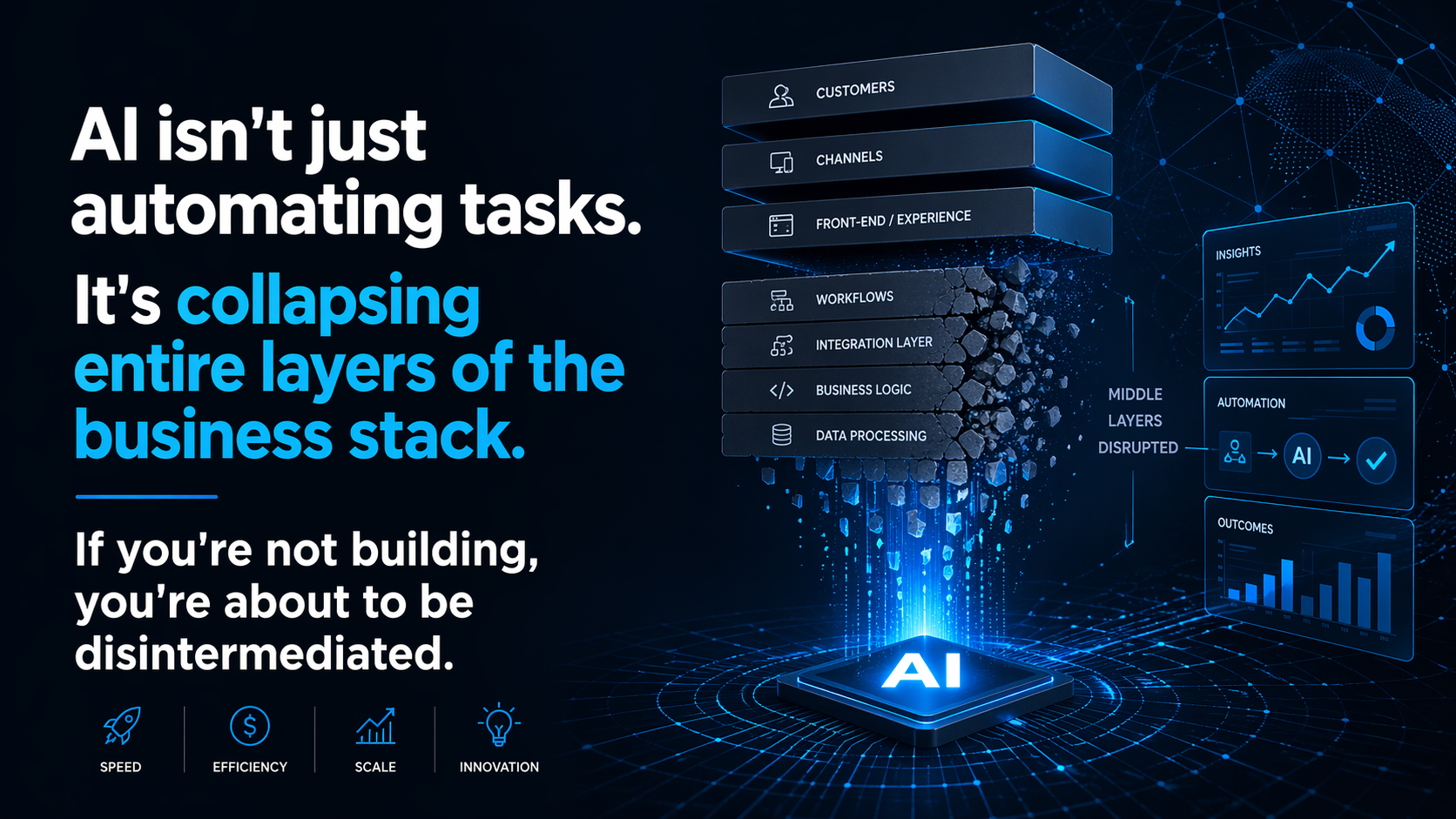
AI isn't just automating tasks. It's collapsing entire layers of the business stack. If you're not building, you're about to be disintermediated.
The Uncomfortable Truth Nobody Wants to Hear
Here's a prediction that will age either brilliantly or terribly: within five years, 40% of today's service businesses will either be dead or fundamentally transformed.
Not because they're bad at what they do. Because what they do won't need to exist.
I'm talking about the middleman economy — the vast ecosystem of agencies, consultants, brokers, coordinators, and intermediaries that have thrived by sitting between problems and solutions. The people who add value primarily through access, translation, or coordination.
AI is coming for all of it.
The Middleman Stack Is Collapsing
Think about what a traditional marketing agency actually does:
- Understand client needs (meetings, discovery)
- Research the market (analysts, junior staff)
- Create strategy (senior consultants)
- Produce creative (designers, copywriters)
- Manage execution (project managers)
- Report results (analysts again)
Now consider what a founder with Claude, Midjourney, and a good analytics stack can do in an afternoon.
I'm not exaggerating. We've seen startups go from concept to launched marketing campaign in 72 hours — work that would have taken an agency 6-8 weeks and $50,000.
Traditional Model:
Client → Account Manager → Strategist → Creative Team → Production → QA → Delivery
Time: 6-8 weeks | Cost: $50,000+

AI-Augmented Model:
Founder + AI Tools → Strategy + Creative + Execution
Time: 72 hours | Cost: $500 in subscriptions
The math doesn't lie. When the cost of doing something yourself drops by 100x, the middleman's value proposition evaporates.
Who's Actually at Risk?
Let me be specific about who should be worried:
The "Access" Middlemen
Recruiters who primarily match resumes to job descriptions. Real estate agents who mainly unlock doors and fill out paperwork. Insurance brokers who compare plans you could compare yourself. Their value was information asymmetry — and AI just made information symmetric.
The "Translation" Middlemen
Agencies that take technical concepts and make them business-friendly. Consultants who repackage best practices. Analysts who turn data into slides. When AI can explain Kubernetes to a CEO better than most CTOs can, what's the translation layer actually providing?
The "Coordination" Middlemen
Project managers whose job is keeping people aligned. Account managers who relay messages between client and team. Operations staff who route requests to the right department. AI agents are already handling this — and they don't take PTO or forget to CC stakeholders.
The Survivors: Who Thrives in the Post-Middleman Economy
Here's where it gets interesting. AI doesn't eliminate value — it exposes where value actually lives.
The winners will be:
The Builders
People who can actually create things — write code, design systems, construct physical objects, build businesses. AI is a force multiplier for makers. A solo developer with modern AI tools has the output of a small team. But zero times any multiplier is still zero.
The Tastemakers
AI can generate infinite options. What it can't do is know which option is right for a specific context, audience, and moment. Curation, judgment, and taste become more valuable as generation becomes cheap.
The Relationship Holders
Trust can't be automated. If your value is that clients trust you — your judgment, your integrity, your commitment to their success — that's defensible. But "relationship" can't be a euphemism for "I schedule the calls."
The Speed Demons
In a world where everyone has access to the same AI capabilities, execution speed becomes the differentiator. Those who can move fast, iterate quickly, and ship relentlessly will outcompete those still running everything through committees and approval chains.
A Framework for Survival
If you're reading this and feeling uncomfortable, good. Discomfort precedes adaptation.
Here's how to think about your position:
Ask yourself: "If my client had perfect AI tools and unlimited time, would they still need me?"
- If yes → You're probably safe, but verify why
- If no → You have 18-36 months to transform
The transformation playbook:
Move up the value chain. Stop doing things AI can do. Start doing things that require AI + human judgment.
Build leverage. Use AI to 10x your output. If you're an agency doing the same work at the same speed, you're already falling behind.
Get closer to the outcome. The further you are from the actual result your client cares about, the more vulnerable you are. Revenue-share models > hourly billing.
Develop proprietary assets. Unique data, exclusive relationships, specialized knowledge that can't be Googled. Generic expertise is worthless when everyone has an expert in their pocket.
What This Means for Founders and Investors
If you're building a company:
- Question every vendor relationship. Not to eliminate them, but to understand what value you're actually paying for.
- Hire for judgment, not execution. Execution is increasingly automatable. The ability to make good decisions under uncertainty isn't.
- Build AI-native from day one. Companies that treat AI as an add-on will lose to companies that treat it as foundational.
If you're investing:
- Be skeptical of businesses built on information asymmetry. That moat is draining fast.
- Look for companies that enable builders. Tools, platforms, infrastructure — anything that helps makers move faster.
- Understand the automation timeline for every service business in your portfolio. Some have years. Some have months.
The Opportunity Nobody's Talking About
Here's the flip side that makes this exciting rather than terrifying:
The collapse of the middleman economy is also the greatest entrepreneurial opportunity in a generation.
Every layer of friction that gets removed is a market that gets bigger. When it costs $50,000 to launch a marketing campaign, only well-funded companies do it. When it costs $500, everyone does.
The companies that will win are the ones helping people navigate this transition:
- AI-augmented agencies that deliver 10x the value at 2x the price (still 5x cheaper than traditional)
- Platforms that give non-technical founders technical capabilities
- Services that combine AI efficiency with human judgment in ways that neither could achieve alone
The Warning and the Invitation
Let me be direct: If you're a middleman, this is your warning. The window for transformation is open, but it's closing.
And if you're a builder — someone who creates, ships, and iterates — this is your invitation. The barriers are falling. The tools are available. The leverage is unprecedented.
The middleman economy propped up a lot of comfortable businesses that didn't create much value. Its collapse will be uncomfortable for many. But for those willing to adapt, to build, to move with speed and clarity?
This is the beginning of the most exciting era in technology since the internet itself.
The question isn't whether this transformation is coming. It's whether you'll be disrupted by it or be the one doing the disrupting.
Choose wisely. Move fast. Build with leverage.
The middleman economy is dying. Long live the builders.