
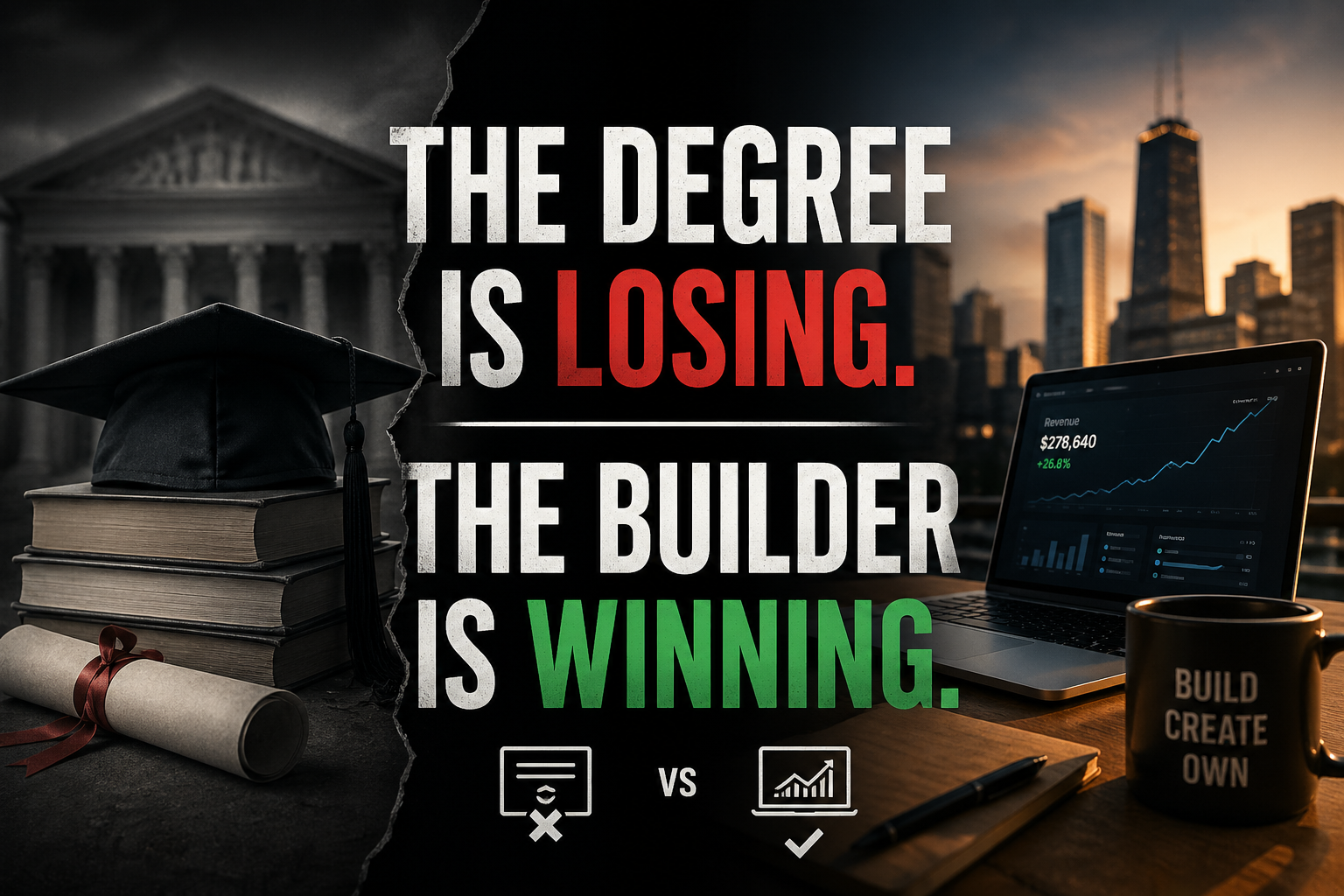
The Degree Is Losing. The Builder Is Winning.
AI isn't just changing what we build — it's exposing who actually knows how to build. Credentials are deflating. Proof of execution is the new currency.
The Quiet Revolution Nobody's Talking About
Something interesting happened last month. We interviewed a candidate with a computer science degree from a top university. Four years of education, impressive GPA, solid internships. They struggled to explain how they'd approach building a simple authentication flow.
The same week, we talked to someone who dropped out after two semesters. No degree. But they'd shipped three apps, built an open-source library with 2,000 GitHub stars, and could articulate exactly why they chose Supabase over Firebase for their last project — including the trade-offs they'd make differently next time.
Guess who got the offer.
This isn't an anti-education rant. It's an observation about what's actually happening in the market right now. AI is accelerating a shift that was already underway: credentials are deflating, and proof of execution is becoming everything.
The Credential Inflation Problem
Here's the uncomfortable truth: a degree used to signal something scarce. It meant you had access to knowledge, mentorship, and structured learning that most people couldn't get elsewhere.
That scarcity is gone.
Today, the entire MIT computer science curriculum is free on YouTube. You can learn system design from engineers at Google, Netflix, and Stripe through their public blogs and talks. Claude can explain distributed systems concepts at 2 AM when you're stuck on a problem.
The degree still signals something — discipline, the ability to complete a multi-year project, exposure to foundational concepts. But it no longer signals what it used to: unique access to knowledge and capability.
Meanwhile, the cost of that signal keeps rising. Four years and six figures for something that increasingly tells employers less about what you can actually do.
AI: The Great Equalizer (and Exposer)
Here's where it gets interesting. AI tools aren't just making education more accessible — they're exposing the gap between knowing and doing.
When everyone has access to the same AI coding assistants, the differentiator becomes what you choose to build with them. The playing field flattens on access to information and basic implementation. It tilts sharply toward those who can:
- Identify problems worth solving
- Ship solutions that actually work
- Iterate based on real user feedback
- Combine tools in creative ways
- Adapt when the landscape changes (which it does, constantly)
A degree doesn't teach most of this. Building does.
The Portfolio Is Eating the Résumé
We're already seeing this play out in hiring. At Ember Studios, our evaluation process has shifted dramatically over the past two years. We care less about where you studied and more about:
- What have you shipped? Live URLs beat credentials every time.
- What broke, and how did you fix it? War stories reveal more than transcripts.
- Can you walk us through your decisions? Architecture choices, trade-offs, things you'd do differently.
- How do you learn? This matters more than what you already know.
The best candidates we've hired recently share a common trait: they've built things in public. Side projects, open-source contributions, indie products, even failed startups. They have receipts.
// This tells us more than your GPA:
const projectsThatShipped = [
  { name: "budgetApp", users: 450, status: "active" },
  { name: "failedSaaS", users: 12, status: "learned a lot", lessonsDocumented: true },
  { name: "openSourceLib", stars: 890, contributors: 23 }
];
The New Résumé: A Trail of Execution
If credentials are deflating, what's inflating?
Proof of work.
Not in the crypto sense — in the literal sense. Evidence that you've done things. Shipped things. Learned from things that failed. Adapted and shipped again.
This shows up in different forms:
1. Products You've Built
Nothing speaks louder than something people actually use. It doesn't need millions of users. A tool with 50 active users who genuinely rely on it tells us you can identify a problem, build a solution, and deliver value.
2. Content You've Created
Technical writing, tutorials, YouTube breakdowns, Twitter threads explaining complex concepts. This demonstrates understanding and communication — both increasingly valuable as AI handles more implementation work.
3. Problems You've Solved in Public
Open-source contributions. Stack Overflow answers. Discord communities where you help others. This shows you can operate in the real-world chaos of production software, not just controlled academic environments.
4. Failures You've Documented
Controversial take: a well-documented failure is more valuable than an undocumented success. It shows self-awareness, analytical thinking, and the kind of growth mindset that survives in fast-moving industries.
The Nuance: Education Isn't Dead, It's Evolving
Let me be clear: this isn't "degrees are useless" clickbait.
Deep expertise still matters. Understanding fundamentals — data structures, algorithms, system design principles — gives you leverage that pure vibe-coding can't replicate. When AI-generated code breaks at scale, you need to understand why.
The shift isn't from education to no education. It's from credentials as the primary signal to execution as the primary signal, with education as supporting evidence.
The most formidable people we work with combine both. They have strong foundations and a trail of things they've built. They never stopped learning, but they also never stopped shipping.
What This Means for Your Career
If you're early in your career or considering a transition, here's the practical takeaway:
Build in public. Start now.
You don't need permission. You don't need to be ready. You need to ship something, learn from it, and ship something better.
- Pick a real problem — something small that annoys you or someone you know
- Build a solution — ugly first versions are fine, shipped beats perfect
- Document your process — write about decisions, trade-offs, mistakes
- Iterate based on feedback — this is where real learning happens
- Repeat — your fifth project will be dramatically better than your first
This isn't just career advice. It's risk mitigation. In a world where AI is commoditizing basic implementation skills, the builders who can ideate, execute, and adapt will have options that pure credential-holders won't.
The Future Belongs to Builders
We're entering an era where the question "where did you go to school?" matters less than "what have you built, and what did you learn from it?"
This is good news for people willing to do the work. The barriers to building have never been lower. The tools have never been better. AI assistants can help you punch above your weight.
The bad news? You can't fake execution. You can't credential your way to a portfolio. You have to actually build things.
The degree isn't worthless. But it's losing its monopoly on opportunity. The builders are winning. And in the AI era, the gap between those who ship and those who merely studied will only accelerate.
The question isn't whether you have a degree. It's whether you have receipts.
At Ember Studios, we're always looking for builders — people with ideas, execution, and a bias toward shipping. Degree optional. Portfolio required.