
The Architecture of Personalized Education: Building the Tech Stack for Higher Ed's Future
By 2030, one-size-fits-all lectures will feel as outdated as dial-up internet. Here's the engineering blueprint for adaptive learning systems transforming higher education.
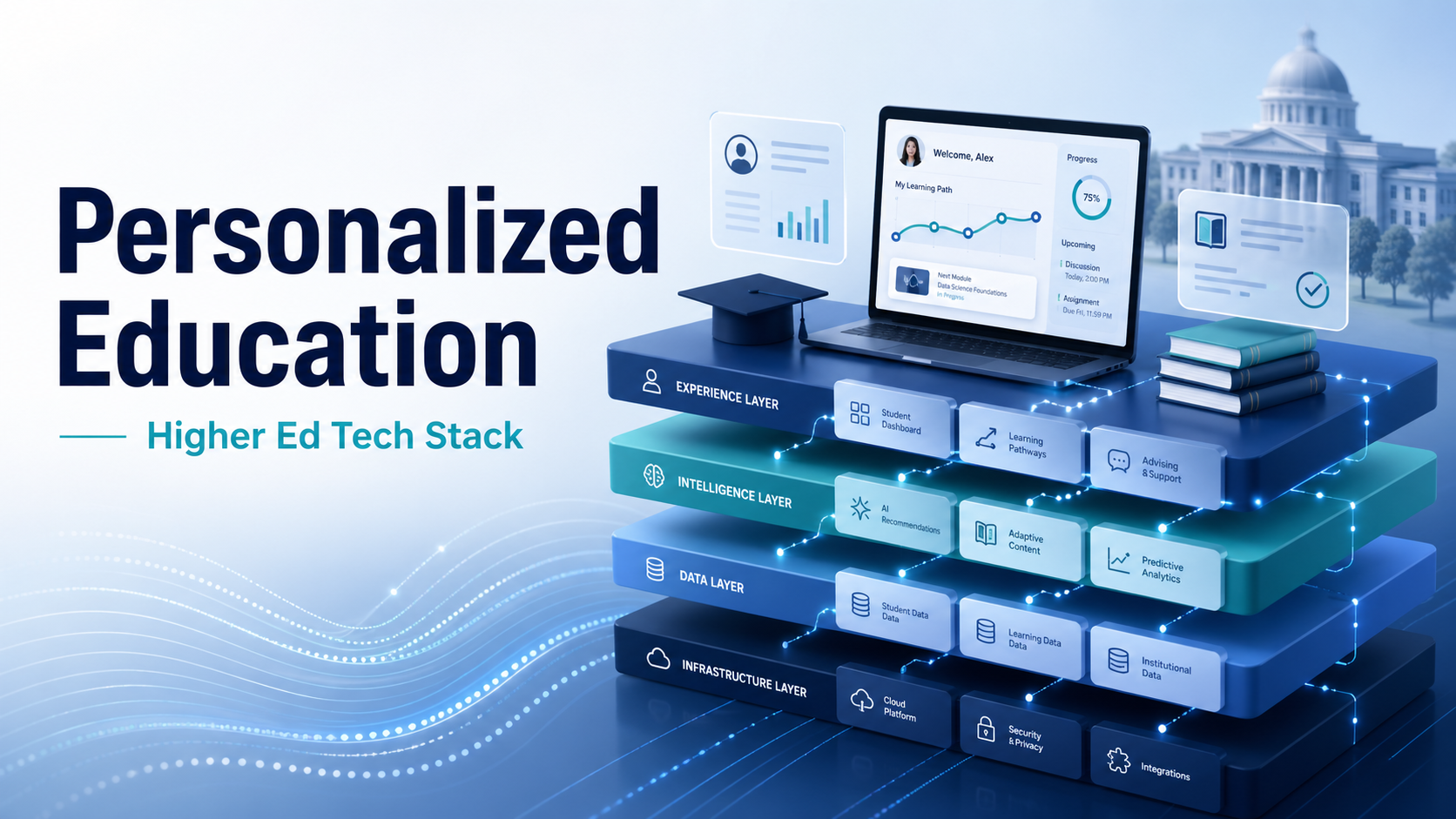
The End of the 300-Person Lecture Hall
Every semester, thousands of students sit in identical lecture halls, receiving identical content at identical paces — regardless of whether they're struggling with fundamentals or bored by material they mastered years ago. It's a system designed for administrative convenience, not learning outcomes.
That's about to change dramatically.
The convergence of AI, real-time analytics, and sophisticated content delivery systems is making truly personalized higher education not just possible, but inevitable. And as engineers building educational technology, we're seeing the architecture of this future take shape right now.
What Personalized Higher Education Actually Looks Like
Forget the vague promises of "adaptive learning." Here's what personalized education means in concrete terms:
Dynamic Content Sequencing
Imagine a data structures course where the system recognizes you're struggling with recursion but excelling at iteration. Instead of forcing you through a linear curriculum, it:
- Surfaces additional recursion exercises with varied explanations
- Connects recursion concepts to iteration patterns you already understand
- Adjusts the pace of subsequent topics based on your demonstrated mastery
- Recommends peer study groups with complementary strengths
This isn't hypothetical — we're building these systems today using a combination of knowledge graphs, spaced repetition algorithms, and real-time performance analytics.
Multimodal Learning Paths
Some students grasp concepts through visual diagrams. Others need hands-on coding exercises. Some learn best from peer discussion, while others prefer solo deep-dives into documentation.
Personalized systems will detect these preferences — not through surveys, but through behavioral analysis — and serve content accordingly:
# Simplified learning preference detection
def analyze_learning_behavior(student_id, session_data):
    engagement_scores = {
        'video': calculate_engagement(session_data.video_interactions),
        'interactive': calculate_engagement(session_data.exercise_completions),
        'reading': calculate_engagement(session_data.text_time_on_page),
        'collaborative': calculate_engagement(session_data.discussion_participation)
    }

    return rank_by_effectiveness(engagement_scores, student_id)
Real-Time Difficulty Calibration
The concept of "Intro to Computer Science" assumes all incoming students start at the same level. They don't. A student who's been coding since middle school sits next to someone who's never written a line of code.
Personalized systems perform continuous assessment — not through stressful exams, but through embedded micro-assessments that feel like normal learning activities. The difficulty curve adjusts in real-time, keeping each student in their optimal challenge zone.
The Technical Architecture Behind Adaptive Learning
Building these systems requires solving several hard engineering problems simultaneously.
Knowledge Graph Construction
At the core of any personalized learning system is a detailed knowledge graph mapping relationships between concepts. For a computer science curriculum, this might include:
- Prerequisite relationships: You can't understand hash tables without understanding arrays
- Analogy relationships: Recursion relates to mathematical induction
- Application relationships: Binary search trees enable efficient database indexing
We typically model these using graph databases like Neo4j or AWS Neptune, with edges weighted by pedagogical research on concept dependencies.
Real-Time Analytics Pipeline
Personalization requires sub-second response to student behavior. A typical architecture looks like:
Student Interaction → Event Stream (Kafka) →
Real-time Processing (Flink) →
Feature Store (Redis) →
ML Inference (TensorFlow Serving) →
Content Recommendation API
The challenge isn't any single component — it's maintaining consistency and low latency across the entire pipeline while handling thousands of concurrent learners.
Content Management at Scale
Personalization multiplies content requirements exponentially. Instead of one lecture on recursion, you might need:
- Video explanations at three complexity levels
- Interactive exercises targeting specific misconceptions
- Code examples in multiple programming languages
- Conceptual explanations using different analogies
This demands a headless CMS architecture with rich metadata, typically built on something like Sanity or Strapi with custom schema extensions for learning objectives and prerequisite tagging.
The Data Science Challenges
Cold Start Problem
How do you personalize for a student you know nothing about? Initial assessment is crucial but tricky — too long and students disengage, too short and you lack signal.
The most effective approaches we've seen combine:
- Brief diagnostic assessments targeting key concept boundaries
- Transfer learning from similar student cohorts
- Rapid adaptation during the first few learning sessions
Balancing Exploration and Exploitation
Should the system serve content it knows works for this student, or experiment with new approaches? This is a classic multi-armed bandit problem.
We typically implement Thompson Sampling or Upper Confidence Bound algorithms, with guardrails preventing the system from experimenting during high-stakes moments like exam preparation.
Explainability Requirements
Unlike recommendation systems for entertainment, educational AI must explain its decisions. When a system says "you should review linked lists before attempting this module," students and instructors need to understand why.
This pushes us toward more interpretable models — decision trees, rule-based systems augmented with ML, and careful attention to generating human-readable explanations.
What This Means for Higher Education Institutions
The Unbundling of the University
When learning can be personalized anywhere, what's the value proposition of a physical campus? Universities will need to double down on what can't be replicated digitally:
- Research opportunities and mentorship
- Peer collaboration and networking
- Hands-on laboratory and studio work
- Credentialing and career services
New Roles for Educators
Professors won't be replaced — but their role will shift dramatically. Instead of delivering content (which AI does better at scale), they'll focus on:
- Designing learning experiences and assessments
- Providing high-touch mentorship
- Facilitating discussions that require human judgment
- Advancing research that informs the curriculum
Infrastructure Investment Required
Most universities run on decades-old student information systems never designed for real-time personalization. The institutions that move first will gain significant competitive advantages in student outcomes and retention.
The Privacy and Ethics Dimension
Personalization requires data — lots of it. Every click, every pause, every incorrect answer feeds the model. This raises serious questions:
- Who owns student learning data?
- How long should it be retained?
- Can it be used for purposes beyond personalization?
- How do we prevent algorithmic bias from perpetuating existing inequities?
These aren't just compliance checkboxes. The institutions and vendors who get this wrong will face backlash — and they should.
Building Toward This Future
At Ember Studios, we're actively working with educational institutions on the building blocks of personalized learning:
- Learning record stores that capture rich interaction data while respecting privacy
- Adaptive content delivery systems that integrate with existing LMS platforms
- Analytics dashboards that give educators visibility into student progress
- API layers that allow institutions to incrementally adopt personalization
The technology exists today. The challenge is integration, change management, and thoughtful implementation that keeps student outcomes — not engagement metrics — at the center.
The Bottom Line
Personalized higher education isn't a distant future — it's being built right now, one system at a time. The question isn't whether it will happen, but who will build it thoughtfully and who will rush out half-baked solutions that frustrate students and educators alike.
For engineering teams, this is one of the most meaningful problem spaces we can work in. Every improvement in adaptive learning translates directly to better outcomes for real students navigating an increasingly complex world.
The 300-person lecture hall isn't going away tomorrow. But its days are numbered.