
Why Smart Companies Are Building Custom AI Systems, Not Buying Them
Enterprise AI platforms promised turnkey solutions. Instead, many delivered vendor lock-in and generic outputs. Here's why the build-vs-buy equation has shifted.
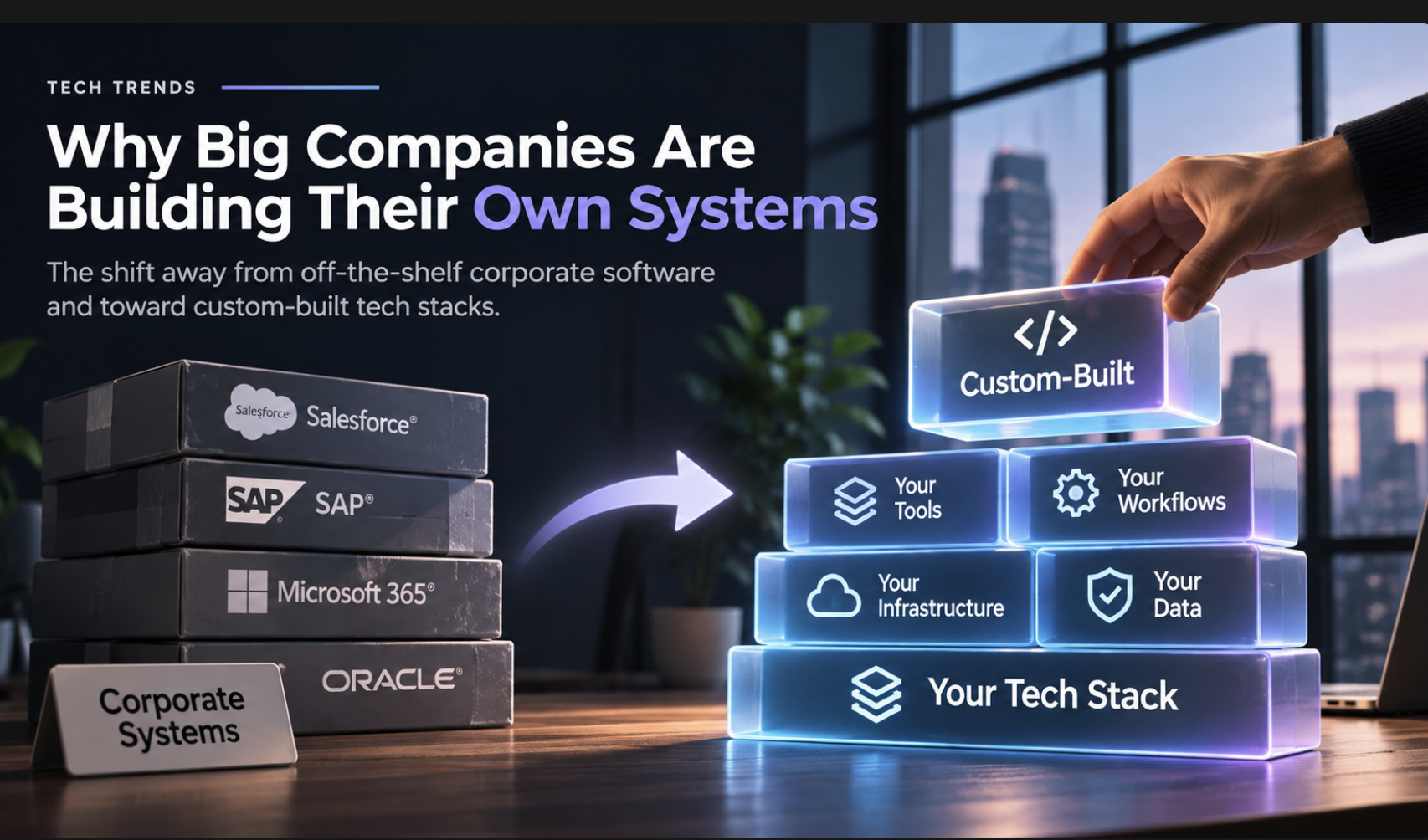
Six months ago, a fintech client came to us with a problem. They'd spent $180,000 on an enterprise AI platform that was supposed to automate their compliance document review. The result? A system that was right about 60% of the time — roughly the same accuracy as a coin flip with extra steps.
They're not alone. Across industries, we're seeing a quiet migration away from off-the-shelf AI platforms toward custom-built automation systems. And it's not because companies suddenly have bigger budgets or more technical ambition. It's because the math has changed.
The Promise vs. Reality of Enterprise AI Platforms
The pitch from major AI vendors sounds compelling: plug in your data, configure some workflows, and watch the automation magic happen. Salesforce Einstein, IBM Watson, Microsoft Copilot Studio — these platforms promise enterprise-grade AI without the complexity of building from scratch.
But here's what the sales demos don't show you:
Generic models trained on generic data. Your business processes are unique. An AI trained on millions of generic documents doesn't understand your specific terminology, edge cases, or domain logic.
Black box decision-making. When the AI makes a mistake (and it will), good luck figuring out why. Most enterprise platforms don't expose the reasoning behind their outputs.
Pricing that scales against you. Per-seat licensing, API call limits, premium feature tiers — the cost structure is designed to grow faster than your usage efficiency.
Integration nightmares. Despite promising seamless connectivity, these platforms often require significant custom development to actually work with your existing systems.
The fintech client I mentioned? They ended up needing three full-time employees just to review and correct the AI's work. The "automation" created more overhead than it eliminated.
What's Changed: The Custom Build Equation
Two years ago, building a custom AI system meant hiring a team of ML engineers, spending months on model training, and maintaining expensive GPU infrastructure. The economics only made sense for tech giants.
That equation has fundamentally shifted. Here's why:
Foundation Models as Building Blocks
OpenAI's GPT-4, Anthropic's Claude, and open-source models like Llama 3 provide powerful base capabilities out of the box. You're not training models from scratch anymore — you're fine-tuning and orchestrating them for your specific use case.
A custom document processing system that would have taken 18 months to build in 2021 can now be deployed in 6-8 weeks. The heavy lifting is done. Your job is integration and specialization.
Infrastructure Commoditization
Running AI workloads used to require specialized DevOps knowledge and significant cloud spend. Now, services like Replicate, Modal, and even Supabase's edge functions let you deploy AI capabilities with the same ease as spinning up a web server.
We recently built a customer support automation system using Next.js, Supabase for data persistence, and Claude's API for natural language processing. Total infrastructure cost for handling 10,000 conversations per month? Under $200.
The RAG Revolution
Retrieval-Augmented Generation (RAG) changed everything. Instead of trying to fine-tune a model on your proprietary data — expensive, time-consuming, and often ineffective — you can now give AI systems access to your knowledge base at query time.
This means your custom AI can reference your actual documentation, past decisions, and institutional knowledge. It's not guessing based on general training data. It's reasoning with your specific context.
What Custom AI Automation Actually Looks Like
Let's get concrete. Here's a real architecture we deployed for a logistics company that needed to automate carrier rate negotiations:
┌─────────────────────────────────────────────────────┐
│                   User Interface                     │
│              (Next.js + React)                       │
└─────────────────────┬───────────────────────────────┘
                      │
┌─────────────────────▼───────────────────────────────┐
│               Orchestration Layer                    │
│    (Custom logic, validation, business rules)        │
└─────────────────────┬───────────────────────────────┘
                      │
        ┌─────────────┼─────────────┐
        ▼             ▼             ▼
┌───────────┐  ┌───────────┐  ┌───────────┐
│  Claude   │  │  Vector   │  │  Supabase │
│   API     │  │   Store   │  │  Postgres │
│ (Reasoning)│  │  (RAG)    │  │  (State)  │
└───────────┘  └───────────┘  └───────────┘
The system pulls historical negotiation data, market rates, and carrier performance metrics. It drafts initial proposals, suggests counter-offers, and flags deals that deviate from established patterns. But critically, humans remain in the loop for final approval.
Total development time: 10 weeks. Annual cost: roughly $15,000 in API and infrastructure spend. Value generated: they've reduced negotiation cycle time by 40% and improved rate outcomes by an average of 8%.
An enterprise platform couldn't have done this. The domain is too specialized, the data too proprietary, the workflow too specific to their operations.
When to Build vs. When to Buy
Custom isn't always the answer. Here's our decision framework:
Build custom when:
Your use case involves proprietary data or domain-specific logic
You need transparency into how decisions are made
The process is core to your competitive advantage
You have (or can hire) technical capacity to maintain the system
Integration with existing systems is critical
Buy off-the-shelf when:
The use case is generic (basic chatbots, simple document summarization)
You need something working in days, not weeks
The AI is supplementary, not core to operations
You lack technical resources and don't want to build them
Most companies we work with fall into the first category for at least some of their automation needs. The question isn't whether to build custom AI — it's which processes deserve custom solutions.
The Hidden Advantage: Iteration Speed
Here's something that doesn't show up in ROI calculations but matters enormously: when you own the system, you can iterate.
Enterprise platforms update on their schedule, not yours. Found a bug? Submit a ticket. Need a new feature? Hope it's on the roadmap. Want to integrate a new data source? Check if it's supported.
With a custom system, your feedback loop is measured in hours, not quarters. Our logistics client has shipped 47 improvements to their negotiation system in the six months since launch. That kind of rapid iteration simply isn't possible with vendor platforms.
Getting Started: A Practical Path Forward
If you're considering custom AI automation, here's the approach we recommend:
Start with a single, high-value process. Don't try to automate everything. Pick one workflow where AI can have measurable impact.
Map the decision logic explicitly. Before writing any code, document how humans currently make decisions in this process. What information do they need? What rules do they follow? What exceptions exist?
Build with humans in the loop. Your first version should augment human decision-making, not replace it. This builds trust and surfaces edge cases.
Instrument everything. Track inputs, outputs, and outcomes. This data becomes the foundation for future improvements.
Plan for maintenance. AI systems aren't set-and-forget. Budget for ongoing refinement, monitoring, and updates.
The Bottom Line
The enterprise AI platform era isn't over, but its monopoly is. Companies now have a real choice: accept the limitations of generic solutions or invest in systems built for their specific needs.
For businesses where AI automation is strategic — where it touches core operations, proprietary data, or competitive differentiation — custom is increasingly the smart bet. The tools have matured, the costs have dropped, and the expertise is available.
The question isn't whether you can afford to build custom AI systems. It's whether you can afford not to.